
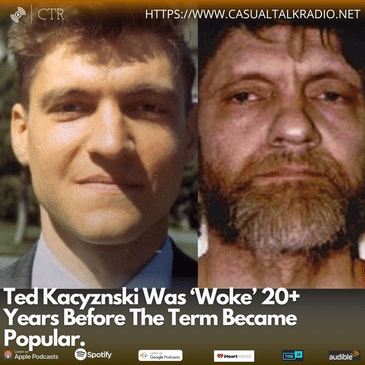
Ted Kaczynski Was ‘Woke’ 20+ Years Before The Term Became Popular.
'Unabomber Manifesto': https://web.cs.ucdavis.edu/~rogaway/classes/188/materials/Industrial%20Society%20and%20Its%20Future.pdf
Follow CTR and Casual Talk Radio:
Website: https://www.CasualTalkRadio.net
Twitter: @CasualTalkRadio
Facebook: @ThisIsCTR
[00:00:04] You're listening to Casual Talk Radio, where common sense is still the norm. Whether you're a new or long-time listener, we appreciate you joining us today. Visit us at casualtalkradio.net. And now, here's your host, Leicester. I'm excited about this upload. I'm separating them out in a very logical manner and I'm satisfied, I think, with this cadence. I think it works much better in the short term.
[00:00:31] The long term is going to be something different. The short term, I think this works. One thing I do have to do, and I've been deficient in doing so, I had a guest on the show some while ago that I would love to reach back out to and invite them back and see if they're interested in co-hosting because I think there was good...
[00:00:58] That person had a very good... They had a perfect radio presence. So I want to do that, I've got to work on that, but my theory, because this person is actually featured in a movie, ironically, and was working through an agent, so it's possible that that person was still actively seeking work in the business. I don't know that.
[00:01:30] But at the time, interest was expressed about coming back on. So I have to commit to doing that. Before I can do that, there are things I need to get set up, which I'm working on, but contractors in this area seem not to have the same time criticality that I do.
[00:01:47] So bear with me. The plan is to get there, but it's a process. I was listening to... I don't know if you've... Chances are you've not. There's a podcast called, you know what I mean? Podcast, which is from Lord Jamar.
[00:02:07] And it's not... I would argue it's not that great of a podcast as formatted, but he has good content. He has good topics. He has intriguing things that are talked about. Whether you agree or disagree is moot. It's... I think it's thought-provoking stuff that's discussed and worth digging into.
[00:02:27] Part of the flaw, I think, and Charleston White is on GLAD TV. Part of the problem, Charleston called it out, is in general, society has a very difficult time just having a reasonable conversation about topics.
[00:02:48] Everything seems to have to veer into the emotional about certain of topics. I'm no different in that regard, but there's less of that for me. For me, there are certain things I will adamantly... you will never change my mind about, no matter what you say, because I'm convinced in what I feel on them.
[00:03:09] Child abuse. Child abuse. When I say child abuse, just to clarify, there was a Dr. Phil episode with one of the members of Color Me Bad. And he broke down three different things that all ultimately are child abuse. And yes, I read what he said, and yes, that's true.
[00:03:34] And the irony is that pretty much every child to a T has gone through all three of those things. But the government does not properly punish parents who subject their kids to any of those three, despite them being abusive things. They are abusive things, and they're not what you would think. Almost every child to a T, at least in the United States, to a T, has been subjected to at least one of those.
[00:04:02] And then it goes down the generations. Parents, new parents, going off what they know, which is what their parents did, they just promote it and keep going with it. And because society has kind of accepted these as norms, well, it's the only way to deal with a bad kid or something else. There's no punishment. Now, we can say, well, there's emancipation, relocation. That sounds good if you're enforcing these things.
[00:04:32] They're not consistently enforced. We see countless stories from Dana Plato, from Different Strokes, all the way down to celebrities I'm calling out to routine people. It's everybody. At a young age, they were abused in certain ways. They only talk about the other kind of abuse that I'm not talking about. I'm talking about the fundamentals of abuse. Every child has gone through it. And then they promote it down the channel.
[00:05:01] In the limited situations where I was in that position, parental, let's say parental role, in the limited situations where I was in it, I remember each and every one of them. At no time, at no point did I ever treat that child the way I was treated as a child. Because it wasn't, it didn't make sense to me. The child might have been bad. I babysat.
[00:05:29] And this person might be listening to the show. I don't know. But I babysat one of them. And bad child. But, but I understood. You're your dad's child. That's clear. You act just like your dad. Bad. I've done that on three, two, three, actually four. Four occasions where I babysat a kid. And I've been in that kind of parental quote role temporarily.
[00:05:59] And they're just, no, they're bad kids. But at no point did I do what Dr. Phil was breaking down. Because just looking at the list, none of it made sense. And then again, in the other ones where it was kind of a more formal parental, no, it didn't make sense. So then when you think about disciplinary, it's, to me, it was simple. There's something the kid's trying to do, wants to do, thinks of doing. And if they want to do it, you put conditions around it.
[00:06:30] You make them earn it. You make them work for it. You make them understand the value of working for it. You're not telling them no. You're telling them you want that. This is what's got to happen. So you make the choice. You're empowering them, but you're really not. Because the choice, you're controlling which choices are viable. So you're maintaining control and dictate over what happens. But to them, it's a choice. And to them, it's empowering. And to them, they get something out of it.
[00:07:00] Viable skills that will help them when they're no longer kids. In my impression, which is why I'm currently not in that, having to do that now. In my impression, it sets the kid up to decouple in a more graceful way. In a way where they're not thinking negatively about the growing experience. There's always the things that happen.
[00:07:27] You know, whether divorces or things that are outside of your control. I'm saying things that are preventable. Things that you can control. You can mitigate a lot of that. In my personal assessment, by just taking the approach that's more fundamental. That we used to do, at least culturally, some cultures. I shouldn't say all because it wasn't all. In some cultures, the way it was used to be done.
[00:07:54] People kind of perceive this as more of, it's more, what's the best word to describe it? In places that are predominantly one specific type of culture. And notice I'm saying culture, not race, because I draw a line between the two. They're one culture specifically. And it's a concentrated type of culture. That's why I was going to say gentrification, but that's not really it.
[00:08:21] But there's a culture that's, it's endemic to this neighborhood that they are protective of. And they don't want it to change. If somebody else comes out and wants to join that culture, the expectation is you will adopt cultural norms. If you reject the cultural norms, you're an outsider and thus a threat. So when I was looking at like redlining, if you don't know what redlining is, look it up.
[00:08:50] I think it's good that you understand the history behind it. But redlining has nefarious roots. Initially it targeted, and I'm going to use real terminology. So I think it's important. I stay true to history and I challenge you to go and look at the history and make sure they're using the same terminology. Because it's important so you understand what their perspective was at the time.
[00:09:16] Redlining targeted Negroes where they did not want the Negroes to be part of the culture. Which at the time was predominantly, I say white American, but it wasn't only. Predominantly. Well, think about why that made sense.
[00:09:37] It only made sense because in the minds of certain people, the presence of those Negroes lowered the value of the properties that the people owned. And having them nearby lowered the value of the properties. You think about this now. Now, we're in a so-called, quote, modern era. The redlining was decades ago.
[00:10:01] But in a modern era, you still see pockets of areas where just the presence of black Americans walking around, the perception is a lower value. It's just, this is lowering our property, having them there. The difference, I think, is depending on that group, that culture that we're talking about, is it simply that they happen to be black Americans?
[00:10:30] Or is it the presentation that the black Americans put forward? Is it the perception of a threat? Is it the behaviors? It's all of that. I'll give you a great example. I am absolutely not the only black American in my area. Absolutely not.
[00:10:52] However, my neighbor, who I believe she's a widow, my neighbor, she's mixed. So, so-called mulatto. She's mixed. So, she's not 100% black American. I think she even might even, I think she might even have some Choctaw. I'm not 100% sure. My other neighbor, white, the other ones are, they're called Hmong, H-M-O-N-G. There's some pockets of Korean.
[00:11:23] There's pockets of Japanese in places. It's diverse. It's diverse. It runs the gamut. Then there are sections, and there's like a major street that separates this. There are sections where it appears to be predominantly black Americans.
[00:11:40] Now, the black Americans from those pockets, if they attend, they come to the businesses, or they attend the schools, or they're somehow in the neighborhood, their presentation is that of low value or depreciated value. Their presentation screams, these are people that are poor. Not because they're dirty. It's not even that. But we talk young people. Bill Cosby talked about, yeah, you need to pull your pants up.
[00:12:09] That kind of stuff. It's pants sagging like crazy for no reason. Hoodies for no darn reason. You know, they're running around in the street with cars to try to do stuff. They don't seem to have any self-awareness of any kind. I just had a situation, and these were workers. Apparently, the lady drove up.
[00:12:32] She blocks my driveway, just parks right at the entrance of the driveway, gets out because she's going to go with somebody else. Notice the guy who's in the passenger seat, who's apparently her boyfriend. He's just sitting there in the car for the longest time, and I wonder, okay, if you just brief drop off, that's one thing, but why are you blocking my driveway? There's tons of curb in this area. There was no reason to stop in front of a driveway that way. This is a lack of self-awareness.
[00:13:01] Now, eventually, the guy gets out. He goes into the driver's seat, but he's still sitting there. He's not, okay, you're in the driver's seat. Drive off. He's not moving. He's just sitting there. So, eventually, I go out. I'm like, hey, what's going on? You're blocking the driver. Oh, I'm sorry, man. I just had to drop my lady off. Okay, but why are you staying here then? He's smoking weed. He's just high as all hell. So, when you're just a weed head, as it's referred to, you lack self-awareness. You lack any respect.
[00:13:30] You don't have, you are not in your right frame of mind. I would argue not to be driving, but still, you're dismissive of property. You don't respect the neighbors. That, right there. That's what then makes it worse from a perception. The perception is that these people, there has never been, and I'm going to make the statement because I think it's important. There has never been a non-Black American that did anything like that, ever, ever.
[00:13:59] I'm talking in my life. It has never happened. It has happened at least three times. Every single time, it's been a Black American. Two of the three times, they were on some substance of some kind. They lack self-awareness. They lack respect for property. They don't seem to think. What is the right thing to do right now? What is the right thing to wear? I would say the right thing to wear, and they get offended. They're sold in the store.
[00:14:26] Or just because they're sold in the store doesn't mean you have to have them sagging off your ass. But they do it anyway. Why? You might be surprised to understand that whole phenom is a prison-originated thing. So why are kids running around doing it that have never touched prison? Because they're inspired by artists who do it, music artists that do it. That's where that comes from.
[00:14:51] If the parents don't discourage that behavior, it gets worse and worse because everybody else is inspired to do it. Why should the parents be the ones involved? Because your parents should want your kid to look somewhat presentable. It reminds me of a distant past time when, despite nobody understood it at the time, I still maintain it was the right answer.
[00:15:17] I pushed to get a specific outfit. Guess. Now, guess today is not what guess was back then. Guess back then was style. Guess now is garbage. I'm talking back then. This outfit was nothing more than black. They were black jeans. They were not these thin, skinny type pants nonsense. They were real pants that didn't show your ankles and didn't hang off your ass. It said very nice, clean, a nice belt.
[00:15:47] And it was a, essentially a white t-shirt with a designer, but it was well-made. I'm pretty sure I had a necklace. And then I had some, I think they were lugs boots. If I recall, they might've been some other shoes. I think I wanted, I think if I recall, I wanted British nights and somebody said, don't wear those because it's BK and it's interpreted as blood killer. I'm pretty sure I went with the lugs. Regardless, it's called dress to the nines. This one outfit, it was one outfit.
[00:16:17] I go to school and there's another person from that era who may remember this situation out because I was walking with him. We're walking down the hallway. This girl, Rochelle stops me in the hall. I'm, I'm, I'm chatting with him. I'm not paying attention to nothing else. Stops me in the hall. Asks for my phone number. I was dressed to the nines. I was style. And I wasn't, I was not flirting with women. I wasn't caring.
[00:16:44] Geraldine's an exception, but I wasn't flirting with her. And it was kind of after what happened with her, I kind of just said, okay, screw all that. Then girls start attraction on me. That was the thing from when my later high school to the jobs I held, I said, for whatever reason, there was a magnetism. A lot of that was being dressed to the nines and actually looking presentable to where I didn't come across like I was stealing to that store revolution down San Diego in the mall.
[00:17:15] And I would go and spend so much money. The guy, I believe he was Korean, South Korean. And he would just say, just give me a thousand. He just, he just cut it off. Cause I was spending so much money. I was basically keeping him in business. And that was a holdover from my brother. Cause he would spend a lot of money. I'm pretty sure he was the one that introduced me to it. The point is I took pride at the time, certainly in appearance out when I was out in
[00:17:44] about where today's kids, it's, it seems like it's a foregone thing. Even some of the adults, I'm, I'm shocked at what I see in presentation. Now, if you're just going down to home Depot, right? Not something I'm talking about. I'm talking about if you're going into a combing, you're going to the DMV, right? Monique, the comedian, she talked about it. Go into the airport and you're in house shoes and flip flops and whatnot. Why, why are you doing that?
[00:18:11] I'm not suggesting wear a suit, but that's what they used to, but I'm not suggesting that far, but at least have some personal pride in what you look like. And then the second part is how people speak, which is another problem. So the perception with all of what I just described speaks low value. It speaks. These are people that have no self pride or dignity and they don't care about themselves and thus don't care about other people's property.
[00:18:41] And they lower the value of the properties around this. I had to understand it wasn't exclusively race. I know this, although the race still plays, it's not exclusive anymore. That's because of the same neighborhood I just talked about. My house is way higher value than everybody else's. The visual, the curb appeal, everybody says it. I don't care what race they are.
[00:19:10] Everybody says it. It's just that the black Americans in this area have no pride in anything. And so they don't communicate. They just go on about their business high off weed. But the Hmong kids are some of the most polite kids I've ever experienced. The white neighbor I have, perfect to work with. The mixed neighbor I have, perfect to work with. They're good people. And then the various contractors and various delivery, they all have said the same thing.
[00:19:39] And sometimes I have the same delivery driver. FedEx driver, same guy. They've all said the same thing. My curb appeal is through the roof compared to everything else in this local region, probably for about a mile radius. It just, it's a high curb appeal and I've not done amazing stuff outside. I've only done basic things, but it only needs basic things for curb appeal reasons. There's more I'd like to do, but to me, that's what everybody should be doing.
[00:20:08] Everybody should be contributing to the overall value. And if everybody's doing their part, it enhances the culture. Because you're setting the message to everybody new, this is what we're striving for. We're not striving to be a slum. We're striving to be high end. We're striving to have quality here. And if you increase the value, what then happens? It prices some out.
[00:20:38] Then society positions that as some form of racism because the low income can't afford to live there. Well, this is true, but it's not because of so-called gentrification at that point. It is, if you've got the money and you're willing to put your own money up to maintain our culture, you're absolutely welcome to be here, which that takes communication.
[00:21:06] It takes the neighbors welcoming those people. It takes the neighbors speaking up about those things. When we had the flooding events, we had a major flooding event. This was mid last year. I had neighbors I've never met before stop by and say, did you get flooded out of the basement? No, I didn't. But I did have a significant amount of water in there that I had never experienced before. But it wasn't like, you know, was I following safety best practices? Absolutely not.
[00:21:35] Because I didn't expect what happened. And things failed that should not have failed. I've since replaced those things. But the point is, it's something I'd never experienced, but I already had the mind that something could happen because it's a basement. I'm not new to basements, but I am new to this size of one. And I didn't do the waterproofing, which is not really waterproofing. So I couldn't trust it. So I already had it in my mind of what is my contingency plan?
[00:22:04] This again goes to culture because if like my neighbors, the one on the right, the white family I talked about, their sump pump has not worked. He said in 25 years, he goes down there and he pumps it manually. When we had the flooding event, I could only imagine what it was he had to do given how much water was dumped in. I can only imagine what he had to do. That means he had to have been walking in arguably waist deep water to get it pumped
[00:22:33] out and it would have taken a long time. Then their basements, I believe finished. So I'm ahead. Neighbors I've never met that see my house in pristine shape after a major flooding event that hit federal level and they're looking at mine and it looks virtually untouched. My lawn still looks immaculate. That's because I put work in because you should be contributing to higher values across the whole neighborhood. Everybody should do their part.
[00:23:03] I did the same thing when I had a house up in Washington state, that house was in terrible shape. The yard was in terrible shape. Everything was horrible. And I went through and cleaned it up to the point that still have photos. Everybody said, no, your curb appeal is through the nines because that's what it was. That house, I bought it for two 65 at the last I checked. It was worth $800,000. My bottom line point, that was essential.
[00:23:30] It wasn't even, I don't even want to call it a slum, but it takes, it takes a village. Everybody's got to contribute. Everybody's got to create the culture that they want to live in and not settle just because of price, which is what I didn't want to do. This is not where I wanted to live at all. It still isn't. But I understood I had to kind of work my way and get to where I want to be with the money I make.
[00:23:58] I could go somewhere else, but let's just do something here. Let's build some net value. Let's use the net value and work towards where I needed to be. I am playing somewhat of a catch up because of COVID. It screwed me. COVID screwed every plan I had because by this point, I should have been living in a million dollar house by now. Everything I'm describing, the culture, the difference between culture and the redlining
[00:24:28] and gentrification and everything I'm describing changed my perception about how racism takes shape. It's not straight line for everybody. For some, it is, right? You're a different race. I don't like you. For some, it's that simple. For some, it's more perceptive. It's more, is that person a contributing member of what's going on? Is that person adding value to the culture that we created?
[00:24:58] And are we all getting better because of everybody else's chip in and contribution? Is that what's happening? Or is this person just dragging us down because they don't want to dress like they mean a damn. They don't want to speak like something intelligible and they walk around looking like criminals. It's now it's a subtle distinction, right? Here's the interesting point.
[00:25:24] In 1996, almost, it's actually just a month now, over 30 years ago, May 1996, Ted Kaczynski wrote his manifesto. It has a different title. I encourage you to go and read it. The manifesto is actually taught in some colleges. That's how important of a writing it was for the time.
[00:25:51] And if you read it end to end, you will understand how much of a clairvoyant sort this guy was. He was essentially predicting the future. If you read what he says with no emotion in your heart, turn off your social media. If you've got a Kindle, put it there and read it without looking at it on a phone. I encourage you to do so. And I encourage you to process what he was saying. And you can freely verify.
[00:26:20] And he wrote that in 1996. And the stuff he says, it predicted everything that we're seeing now. Almost to a T. I can't overstate how brilliant of a man Ted Kaczynski was. If you never heard the name Ted Kaczynski, so-called Unabomber.
[00:26:47] Ted Kaczynski was probably the most, one of the most, I can't say the most, one of the most brilliant people ever born. And I'm not, again, I'm stressing, this is a guy who had some of the highest credentialing that you can get through college. Extremely brilliant technology-wise. This is a guy who was an educator.
[00:27:11] This is a guy, if you look at everything that he was skilled and technically apt to present, he was doing things that nobody his age should have been pulling off. And this goes beyond IQ because some of that was taught, some of that was observed. He took everything that he learned as part of that system and the things he was hearing.
[00:27:38] And this is no different than now because some of the college kids today are being taught different technologies and they're learning about AI and all these things they're being taught. The only thing different with the way Kaczynski interpreted what he was being taught and today, he looked at it at a critical eye. He looked at it with criticism. He looked at it saying, that's going to be a problem. That's a concern. That's going to be, what about the impacts of this?
[00:28:08] He actually analyzed it. He didn't just go full scope with it. He actually was thoughtful in what are the impacts of what it is we're telling people about this. That reminds me, my brother, the one that still lives, told me once about how Pascal was going to change the banking industry. This is before a time when they were freely giving out debit cards and before ATM machines were widely used.
[00:28:37] And he would tell me constantly, Pascal is going to be the future of banking. Pascal not only helped transform banking, Pascal's roots helped spawn what we know of now as cryptocurrency. He had that same kind of foresight of this is what I'm seeing in school and I can see where this can go. That's what Kaczynski's, that's where his mind was going.
[00:29:04] Now, there were other controversies around Kaczynski and how he took his knowledge and presented it to the world. He went through certain studies. He went through certain things around that time. And I don't think they were directly relevant per se to what happened to him. I honestly don't think so.
[00:29:28] In my mind, everything that happened to him later, for me, it was, this was a guy that was just directly influenced by everything that was around him. People don't know at a point he actually considered gender transition surgery. And it was denied initially and then approved.
[00:29:55] And then when he went to go do it, he changed his mind and backed out of it. But after all this back forth, right? This is like the, it's like a light switch went off in his head where he started to lash out at everybody. For no clear reason anybody could understand.
[00:30:19] This was the start of kind of the spin down where he was doing, you know, the letters and the attacks where there wasn't really a clean reason why he was doing what he was doing. The manifesto shows up, presumably to try to explain it. They couldn't even really get close to catching the guy until he started putting the writings out. That's how smart he was.
[00:30:41] And later it was determined that a lot of what he was doing was designed to instill the same level of concern in other people. Like it wasn't that he had, you know, the highest level of ethical moral. It was like warning. It's like, you're not listening. So I got to do this to get you to listen to me type of thing. It's, it's, it's radical. Later he would divulge, you know, it's, it's not that I was trying to directly kill somebody.
[00:31:11] Or any of that. I'm trying to, they're not listening. And I'm trying to get people to listen. They're not listening to me. And that was his, that was his stated reason he was lashing out at people is they're not listening. So I got to do something. I've got to get some sort of focus on me because they're not listening. In the manifesto, he talks about a lot of concepts that will concern a lot of people in the modern era because they've been conditioned to accept certain things as okay.
[00:31:41] And he challenges a lot of these narratives. He challenges a lot of the terms that are used, specifically, even the impacts of racism is called out in there, believe it or not. And he's thoughtful about what he's, what he's positing around it.
[00:32:02] When we talk about the nuclear family, the nuclear family is the simple concept that you have a husband, a wife, kids, and you raise according to traditional values. That's a simplified version of a nuclear family.
[00:32:19] Kaczynski goes into some details and he specifies what he believed was the real driver behind the nuclear family's value to the overall culture. That's why I started with the culture separation. I'm going to simplify what he's saying because I want you to read the whole manifesto.
[00:32:42] Put simply, modern society at some point in the past, and I can't even go back as far as suffrage because I don't think it went that far. This seemed like it started sometime in like the 70s or the 80s, possibly the 80s.
[00:32:56] Modern society went to this mantra that said that we should instead strongly encourage women to go to work, be independent, be self-sufficient, and not be satisfied being the homemaker. And I talked about the book, and at some point I'll do an episode about it, but there are people that were trying to push back to that mantra.
[00:33:24] You heard the trad wife fad that came and went, where some of that was true and some of that wasn't. It was kind of smoke at points. What Kaczynski posits is, well, let's understand what's pushing that narrative, what's driving that push towards women being self-sufficient, women having jobs, et cetera. It's because we have a contradiction. This was the intriguing part. And these are my words, not his, but we have a contradiction.
[00:33:52] If you look at racism and discrimination, they don't make any sense because you're excluding people who otherwise are valuable resources that would make us more productive.
[00:34:06] It might surprise you to learn during the industrial age, a lot of what eased embracing black Americans into society was the realization that they could be resources to work. And as resources to work, it would increase productivity.
[00:34:28] Increasing productivity would help things keep a pace, especially after the world wars where we had a population crisis because of people dying in the wars, et cetera. And they wanted to initiate birth rates spikes. Well, we understood we've got this whole population of people over here. We've got black Americans over here. We've got native Americans potentially there. They want to work.
[00:34:54] They want, but, but in order for them to do certain jobs, they have to be educated. So if we suppress their education, they can't work those jobs. That means they are not an asset. They're not a resource. We can't use them. We can't benefit from them. So they're a drain because they're not benefiting the overall culture. They're draining.
[00:35:18] So the first approach, and it's appropriate, this is happening the day after on the Juneteenth deal. The approach, initial approach was to say, we're going to exclude them and we're going to remove. So think trail of tears with native Americans. We're going to exclude. We're going to remove. We're going to blockade. We're going to segregate because they are not adding to our culture. They are not benefiting our culture.
[00:35:48] They're not enriching our culture. They are lesser. They're not on our level. This that Kaczynski is positing, which again, I believe was central to some of the awareness that happened in the past. The concept of civil rights was there. They could be resources, but if we keep doing that, all we're doing is increasing the drain and we're not benefiting from what's basically a rich resource pool of people.
[00:36:18] That was the real, like we never got rid of true racism. When we say civil rights, the concept of civil rights was not because people were, people had the best of intentions or they were looking out for best interests or any of that. That wasn't the real driver. The real driver is this is a resource pool. Why don't we accept it as a resource pool? And what does that mean?
[00:36:46] That means they need to be educated in order to take advantage of the resource pool, but then we can use them. Now, in order to make that make sense, we're going to need to pay them. Now we get into pay quality issues and everything else. I won't bore you with here. Suffice to say that what Kaczynski then later posits is racism and discrimination never made any sense because you're excluding a whole set of people from the workforce.
[00:37:14] But with this women's rights and equality movement pushing women to discourage the narrative of being a housewife, that they should be self-sufficient, they should bust their tail and work hard, etc. And so on puts the family, the nuclear family at risk, which we see now makes it harder for the nuclear family to thrive and survive. If that happens, what happens? It means our population gets put at risk.
[00:37:44] Not only that, but it also means that abuse in the household goes up. Why? Because of frustration, which is almost always the trigger for these abusive things. It's not that we hate the kid or any of that. There are certainly situations where certain parents who never should have been parents come in the mix. I'm talking about in the regular day to day. You see a story about a murder, suicide. Some guy came home. He's frustrated. Kills his wife and kids.
[00:38:12] That's a that is indicative. This is my words, not Kaczynski's. That is indicative of a nuclear family where there's something that's wrong. Because if you have any notion of killing your own wife and killing your own kids, something's wrong that had not been fixed prior to it getting to that point.
[00:38:38] Kaczynski's messaging gives a strong statement that a lot of that is spurred on by the push for women to be independent, self-sufficient, stand alone, etc. And so on, instead of embracing a traditional role. There are people out there that will be infuriated by what I just said. My question would be, why does that infuriate you? Because if you think about it, there's logic in what he's saying.
[00:39:04] There's logic in this idea that because what it's saying is. The woman, the wife, the mother. Is the nucleus is right at the dead center. Of a stable household. The man is the one who's contributing to what it takes to keep it that way. But the wife, the mother.
[00:39:28] She is the one that's using that resource to benefit the household and keep it together. Keep it consolidated and consistent. If we accept that then. And this is talked about later in Kaczynski's write-up. If we accept that then, we can directly trace back why everything seems like it's more difficult than easier.
[00:39:55] We then said, well, we got to get these black Americans into the workforce. Okay? Now we got to get these women into the workforce. Now everybody is just working and consistently having to feel as if they got to work harder and harder and harder with less to show for it and less return. Women get frustrated at a point if they wanted to be mothers because they can't find the time to settle down and do it.
[00:40:22] Men get frustrated at the inability to find women who want to be mothers and want to let them, the men, be the one who provides, the primary provider, I should say. So everybody is frustrated. If there is a family, whether incidental or purposeful, the children feel neglected because the parents are having to bust their tails just to keep up with the Joneses.
[00:40:50] All of that is because the machine that's above us has kept asking for more resources, has asked for more people to work, has asked for more people to contribute while giving less back. Because inflation takes away the value of what you've made. Forcing the woman and the man to both have to work to keep up with the prices of things. The prices of things skyrocket because the supply is necessary to do them.
[00:41:20] Has increased. In Kaczynski's write-up, he talks about the fact that in the older eras, independent smaller players could create products and then offer them on the open market, which helped keep costs down. As modernization and the industrial age evolves, there's more dependencies on all these different corporations. And the more corporations involved, the higher the cost of things.
[00:41:50] Because there's so many involved, they need more people and that creates more of a pull. It's draining all the people. We have to have more people, more people, more people. The cost goes up because the cost goes up and salaries don't go nearly as high as they could. It creates this, okay, you basically are forced to have a dual income family in order to keep up with the Joneses. AI comes in play later.
[00:42:19] Now there's a threat of jobs because the companies, those same corporations who have over years absorbed, this is me now, have absorbed a lot of those smaller players or just simply forced them out of business. They have now left you less options to buy from, which drives prices higher because you no longer, though they can't compete with the big players.
[00:42:43] Since prices are driven up and the corporations can now leverage AI, they need less people. It's not that they don't need people, they need less of them. They need decision makers, not necessarily doers. Many of the people who are being displaced are in the white collar.
[00:43:01] The white collar has no real protections because they lobbied to say this set of people, it's a fixed salary, you're not eligible for overtime, and you can essentially be fired at will. You don't have any protections. They got rid of pensions. You were left in a fragile state and it was frozen in time.
[00:43:27] The white collar that we see now represents a time, this is the honest truth, it represents a time before women were encouraged to join the workforce. At the time that the white collar came to be, it was like opening the doors for a bunch of people to come in while managing how much additional spend needed to happen.
[00:43:55] The blue collar was demand-based. There's demand for products and services. We need people to deliver it. The blue collar, physical work, robots can do some of it. It can't do all of it, especially not fine type work, sewing and knitting and things.
[00:44:15] When the blue collar started to get attacked as low value work and the white collar was the focus, which went to the colleges who started to promote STEM-based degrees, the cost of college education skyrocketed. At some point in a future episode, I'll give my experience about the federal student loan industry. I did one episode.
[00:44:43] I'm going to do a follow-on because once you understand all these, and I've been exposed, that's why I know some of this. Once you understand all of this and how it's all interconnected, it's fascinating, but it's also infuriating, right? And I've always said somebody like Kaczynski, somebody who is strong of technical mind, they're the people you should be listening to, not the people who are just dumb influencers.
[00:45:08] When I say dumb influencer, I'm talking somebody who's just telling you something and they don't really understand it. They're just telling you what somebody told them to tell you. I'm talking the technical minded that's been through these things. This college education system, the focus on STEM, the increased focus on STEM degrees, the decreased value of liberal arts degrees and liberal arts programs,
[00:45:29] the increase in college cost is directly connected to the loss of private federal student loans. Private federal student loans provided cost balance and helped offset the spend necessary to learn the skills necessary to do the workforce. Businesses then created their own assumption about what that worker was going to come in already knowing,
[00:45:59] So when businesses initially, all they needed was a high school diploma, then it was you need an associate's degree, then it was you need a bachelor's degree, then it was you need a certain type of bachelor's degree, then it was master's is preferred. They didn't have any foundation for why they required all that. And most of that is not blue collar oriented. So it didn't make sense. But if you wanted to get into a blue collar job, it was easy to do, but they paid pennies.
[00:46:26] Because the machine over top of all of it steered everybody into one specific direction, which is the direction we rushed into. And now it's kind of too late because now you're seeing AI is currently the messaging and jobs are put at risk. Well, think about it. If they don't need you because you were told and sold a bill of goods about STEM.
[00:46:52] If they don't need you because this computer over here could just do your job. Do you think the government's going to take care of you? You can say Social Security. We understand Social Security is a Ponzi scheme, which I've talked about before. Maybe I'll revisit. It's a Ponzi scheme. It's a textbook definition Ponzi. What it is. On a different episode.
[00:47:16] This is why I say my cadence is perfect because then all of a sudden everything became much clearer about what I need to position. In a different episode, I'm going to talk about R. Kelly. Because R. Kelly's story connects in one very abstract way. And that is the man act. M-A-N-N act. It all connects to what I just broke down.
[00:47:41] And when you think it through, if you think it through without the emotion, you will understand why everything to date is all about this machine guiding stuff. The more you follow, because you kind of have no choice, the worse it gets. And the worse it's going to be for the future generation. And Ted Kaczynski already had a pulse on it 30 years ago.
[00:48:09] You can read it and I want you to read it yourself and understand there's nothing he's saying that's fundamentally wrong. He's putting out a position that he felt at the time, long before social media wasn't a glint in anybody's eye when he wrote that. That's how bad it is. When he wrote that stuff, we were all on web TV. We were still on dial up. We were on America Online. We didn't have the concept of, quote, social media back then.
[00:48:38] Not anywhere near like we had CompuServe, but that doesn't count. Right? Prodigy. But that doesn't count. We had IRC. We had ICQ. We had very rudimentary. I think Facebook might have existed. MySpace might have existed. We had very rudimentary, GeoCities. Very rudimentary, but not like what we have. We also didn't have steered news. We also didn't have, quote, influencers like we currently do.
[00:49:04] It was a different time, and yet he was able to foresee a lot of what we currently see. It's just, it's so piecemeal and separated. Nobody ever did a good job of putting it all together. You're like, well, back to the beginning, how does Lord Jamar fit into that? Because they were talking about the Mann Act, and they were talking about R. Kelly, and they were talking about the real driver behind R. Kelly's situation,
[00:49:29] which connects to Epstein in an abstract way that I'm going to talk about on that episode because it needs its own deal. Because once you put it together, you start to understand the game. Mine is not to tell you what to do other than to understand the game. There's a game. You're being duped. You're being lied to. You're being misled. What's my personal assessment? I believe in the nuclear family. I believe the nuclear family is the one thing we lack.
[00:50:00] That takes women that are courageous enough to accept it's okay not to work hard. As long as one of you is working hard, it's cool. It doesn't necessarily have to be him, but one of you needs to be the one working hard, and somebody needs to take care of the household, and that's fine. That's perfectly fine. But it helps as a mother when you start having children if you can be the one that's not working hard outside of the home.
[00:50:28] Because as a mother, it's arguably, from my perspective, more important for you to see to that child or children and what they need, first and foremost, once they're out of the house, you're still there for them, but you don't need to be a full-time mother, per se. You can become a part-time mother because you're not having to attend to their specific nuances as they're in their development phases. Thank you.