
TL:DR: with load shedding on a TOU plan and not using the Smart Home Panel 2 yet - just going off of plugged in device shedding, the amount of kWh energy consumption increased, but the monthly electric charge was lower by $3 despite a rate increase. But it takes a fairly significant upfront investment to get to that point.
What is "Load Shedding"?
Simple definition: If your utility company rips you off during peak hours, you're storing energy to be used during those hours instead of tapping the grid. The grid is then used to recharge the stored energy during off-peak hours.
Certain energy companies (i.e. Xcel Energy, or at least last we checked) will set you up with "time-of-use" (TOU) rates automatically. Others (i.e. WE Energies) force you to contact them to ask for it; meaning you're possibly getting ripped off until you do and wouldn't know it.
This is why generators by themselves are fine if you only have the one problem (outage mitigation). They fall short for Load Shedding except for when gas prices are significantly low; and even then, the runtime may not make it worth it. Stored energy, not just Ecoflow, when paired with one or more energy sources is how you get to the true benefit.
Who benefits most from Load Shedding?
You are a textbook case if:
You and/or your spouse(s) work from home
You and/or your spouse(s) do college from home
Your kids are home schooled
One or more of you are heavy online gamers
One or more of you are heavy into streaming media
The point is, If you use a lot of energy during peak hours, Load Shedding can benefit you.
How is the ROI for Load Shedding?
Depends on your consumption.
The average home uses ~30kWh of energy. But there are a lot of assumptions to that number. As work-from-home consultants we use ~15kWh on average in the fall and winter even including the steam humidifier, the hungriest device.
It's an older home, so it tends to be drafty. Sealing up homes (including foam insulation, which we DO NOT like) too much results in humidity problems as well as air quality issues especially VOC (organic stuff from cooking); homes need to breathe at least a little. But we determined that we basically just need to replace the single-pane windows all around and weatherize the attic entrances for a significant benefit. That will drastically lower the amount of runtime for HVAC appliances.
Step 1: do small things around the house to help minimize runtimes and thus, lessen necessary battery capacity.
Next we needed to determine how much capacity we need in the worst case. Unless you have a smart panel or one of the other devices that can show you output at the circuit level this is a best guess most of the time. WE didn't use devices like Sense (found on Amazon), but it comes fairly highly recommended and doesn't seem to need an electrician to provide useful data.
In our case, we know that we can survive on 6kWh; but our worst case use is around 20kWh, with 30kWh being "normal and inefficient". So we started with separate units with a 6kWh capacity and ran for a few days, identifying that we theoretically could make that work. But it wouldn't be a comfortable situation. During an outage, we had phone and lighting plus computers and internet, and could use separate air conditioners and space heaters for at least a finite period of time.
Step 2: figure out how much capacity you actually can live with, and create an outage plan , where you'd identify critical stuff to be powered only, if you had no grid available. Either focus on survival (minimum) or comfort (maximum), understanding that "comfort" is very likely to be very 3x the price compared to "survival".
The caveat is that consumption will vary in spring/summer vs. fall/winter. Here, summer tends to be fairly sunny except for spotty heavy rains; fall and winter less so. Solar energy is still present pretty much every day, just significantly lower when overcast. So we tested a few solar types (would share but apparently it's perceived as a sales pitch), and settled on a design that should get about 1kWh minimum in the summer and roughly 200w minimum in fall/winter; which is more than enough to achieve the ultimate objective, which is to lower consumption without losing functionality.
During the summer, the consumption estimate is about ~20kWh; however, we can offset consumption with solar energy for at least 4 or so hours of the day to stave off the brunt of energy loss, using panels in series.
Step 3: if solar works, use it, understanding it's part of the upfront investment.
Last, we needed to understand the rate plan. Most utility companies send you an overly wordy pamphlet knowing people won't read it - we highly recommend you do so you can understand what you're being charged, when and why. Once you understand it, if there's a TOU plan available, do it for a slot that works around when you consume the most energy. You might not get perfect science (say, if your work-from-home schedules are 10-7) but you should be able to shed quite a bit of it if you're creative.
Step 4: the savings really depends on how much you're getting charged/ripped off.
Given everything above, here's a real-world savings outcome - keeping in mind that everyone's savings will vary. This is only electric.
In order to determine recoup of just the amount invested, we looked at on-peak vs. off-peak, and dug into two months - one in summer and one in fall.
First up: August 2025 (summer out here), the heaviest consumption month thus far (1681kWh). August 2024 is before any sort of real load shedding. It's also prior to switching over to TOU rates.
Month/Year | kWh Consumed | Billed |
|---|---|---|
Aug 2024 - Regular Rate | 1,370 | $273.72 |
Aug 2025 - TOU Rate | 1,681 | $306.59 |
What's going on here? Well, the regular rate nets out to about 20 cents/kWh when you factor in all of the various BS fees and whatnot; but it goes no cheaper based on the time of day.
The TOU rate, by itself (minimal load shedding and conservation) only really saved about 2 cents per kWh. But because of this savings, if your consumption is higher in the off-peak, you end up not getting nailed to the wall during spike periods (i.e. evening streaming marathons). It means you can use more without a significant bill hit.
Now, let's contrast that with October (fall out here). October 2024 was still no TOU.
Month/Year | kWh Consumed | Billed |
|---|---|---|
Oct 2024 - Regular Rate | 830 | $172.89 |
Oct 2025 - TOU Rate | 1,184 | $170.70 |
A net regular rate of about 21 cents/kWh in 2024.
In 2025 (which is TOU and 75% load shedding) it's a net of 14 cents/kWh) - a bit over 30% savings. Which went towards allowing more consumption without the cost hit.
You're not misreading. Consumption went up 350kWh but the bill went down. Here's what happened.
Starting in roughly September and month-over-month we took advantage of discounts to stack up capacity for separate units and distributed them throughout the home for different consumption needs.
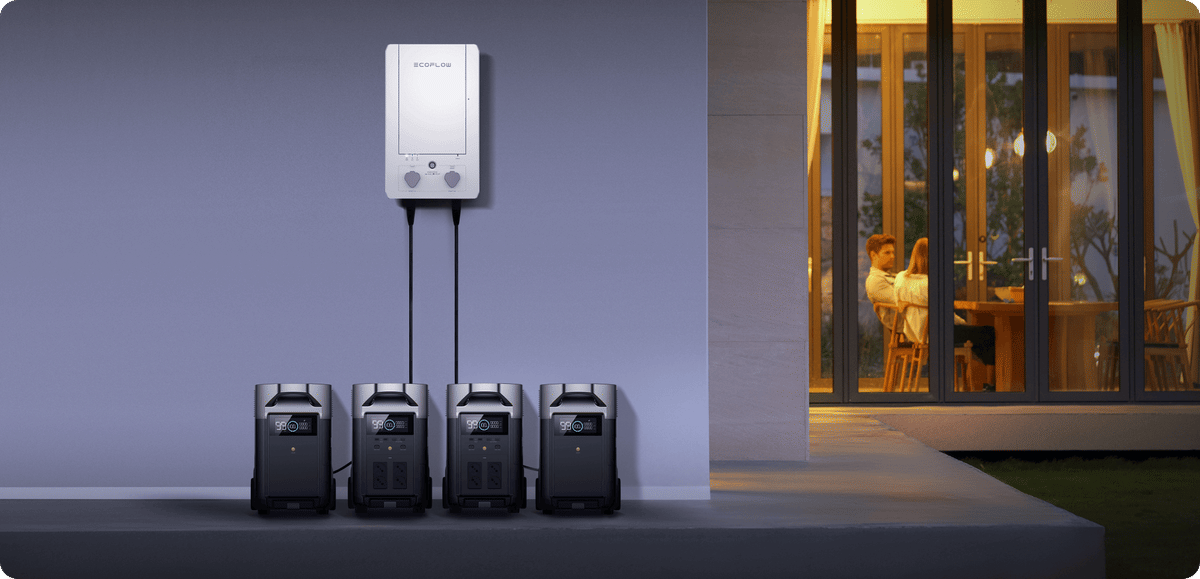
During on-peak hours, all of the plugged-in devices ran off of the various Ecoflow devices that eventually totaled about 15kWh of total capacity. Just plugged-in devices.
This included every kitchen appliance other than the stupid food dispenser which is bizarrely hard-wired into the overhead lighting.
Where and when possible, solar was used to offset discharge; so for example, if the dehumidifier needed to eat 600w but the solar could bring in 400w, that extended the battery runtime (this was all handled by a single DELTA Pro in the basement).
During off-peak hours, all devices then recharged themselves. All other items just powered from grid.
This was managed using a set of smart outlets. The only plugged-in item that wasn't using Ecoflow is the plug-in hybrid, because the smart outlet was sufficient to manage a charge/discharge cycle anyway plus force it to be off-peak.
But that's not really ROI, is it? Because the missing element is investment.
Reaching the result above took an overall investment - over multiple months and timing with various Ecoflow discounts - of about $8-9k. Spreading it out over months was strategic; until we could determine the "sweet spot" of capacity, and until we could identify the real heavy hitters, we didn't want to fork over too much per month.
Referring only to load shedding, it would take a substantial number of years to recoup the investment, assuming an average savings of about $60-120 per month over regular pricing and about $200 per month over on-peak pricing.
Summary
To effectively load shed, the upfront investment is going to be way higher than what you'd save or spend otherwise.
Consider though that load shedding is only one of many reasons to buy storage units. There's outage situations too (where if you need the energy to work, it's insurance against a loss of income for example). For outages a generator might make better basic sense.